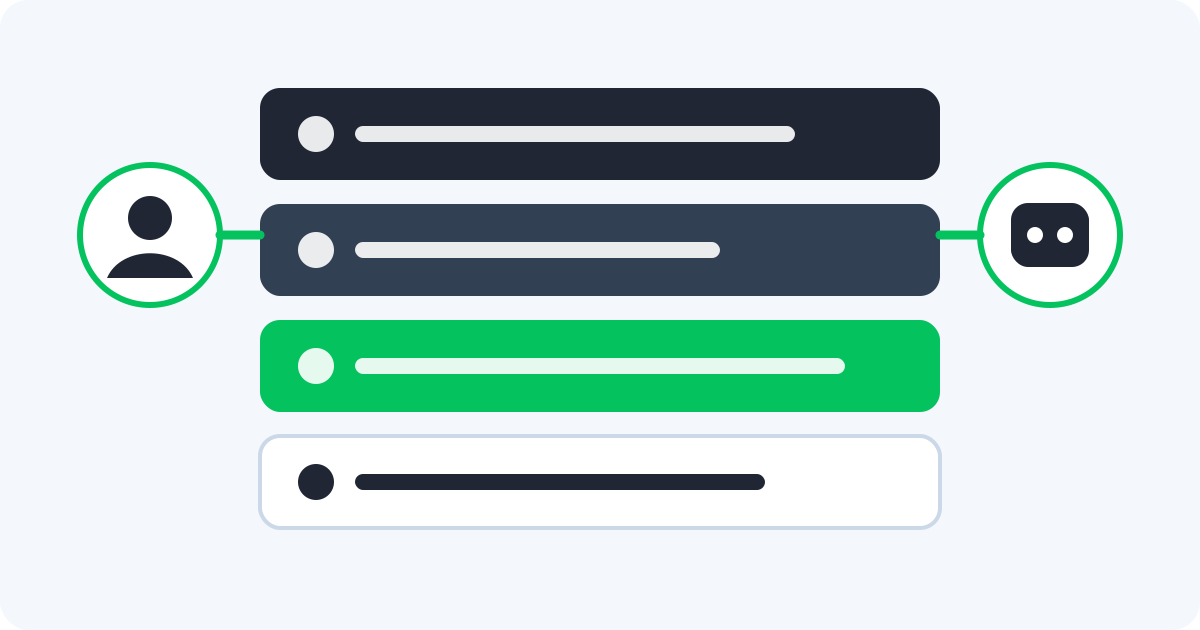
AI does not replace CRM. It changes the interface through which CRM is used. A person traditionally opens Salesforce in a browser, finds a record, completes a form, and launches a process. An AI agent can discover and invoke the same capabilities as tools, without imitating clicks in the user interface.
From an application to a platform of capabilities
Salesforce describes this shift through Headless 360 and Hosted MCP Servers. Model Context Protocol provides a standard connection between an AI client and platform tools.
Depending on the permissions granted, a compatible agent can search and read CRM records, create or update data, invoke Flow or Apex, use a prompt template, and work with Data 360 or analytics. The same capability can then be used by ChatGPT, Claude, a developer tool, or a custom enterprise agent.
Four layers of the current Salesforce proposition
| Layer | Role |
|---|---|
| System of context | Connected customer data, knowledge, and events, including Data 360. |
| System of work | Customer 360, CRM applications, processes, automation, and business logic. |
| System of agency | Agentforce and other internal or external agents that reason and act over the platform. |
| System of engagement | Salesforce UI, Slack, or another environment in which a person or agent works. |
The browser remains important, but it is no longer the only entry point. Salesforce becomes a source of context and governed capabilities that can be consumed where work already happens.
MCP does not bypass the security model
Hosted MCP servers are disabled by default and enabled by an administrator. Tool calls use per-user OAuth authentication and respect object permissions, field-level security, and sharing rules. An agent can therefore do only what the identity under which it operates is permitted to do.
This separates an enterprise implementation from a prototype using a broad API key and a data export. Production value depends not only on the quality of the model's answer, but on identity, access, auditability, and the impact of each action.
The client can choose the model
Salesforce supports managed and partner models and can connect an externally hosted or client-operated model. Two architectural patterns should not be confused:
- An external agent uses Salesforce through MCP. Salesforce governs access to its data and tools; the client must govern how the external AI client handles the returned data.
- A model is called through the Salesforce model layer. Trust Layer capabilities can apply, including grounding, sensitive-data masking, audit, and contractual zero-data-retention arrangements with supported providers.
“Use our own LLM” is therefore not a complete architecture. The entire data flow, agent identity, decision points, and accountability need to be designed.
AI increases the value of good CRM — and the cost of its weaknesses
An agent quickly amplifies what already exists. It can scale a good process and perform an unclear one inconsistently. It can use sound data and turn bad data into bad decisions. It can respect appropriate permissions, while overly broad permissions increase risk.
What changes in CRM design
A process can no longer be safe merely because a button is hidden in the UI. Rules, validations, and permissions must be enforced at the level of data, automation, and business logic. Every capability needs to be designed for two kinds of user: human and agent.
The agentic era does not reduce the importance of CRM architecture. It moves attention from individual screens to enterprise capabilities, context, and governance. That is where the difference between an impressive demo and a safe operational solution will be decided.